


Workforce Mobility Special Interest Group

Globally, people are moving to work, and work is moving to people - the economic forces are strong - so how can technology be used for assessment and qualification in increasingly international labour markets?
By 2030, there could be 85 million unfilled skilled vacancies globally, largely because skills and jobs are not in the same location.
A world of free movement would have nearly double the economic output.
The e-Assessment Association Workforce Mobility Special Interest Group (SIG) brings together professionals with a shared interest in workplace assessment to collaborate, learn, and advance their expertise. The purpose of this SIG is to accelerate learning on the use of technologies for assessment and credentialling in an era of international workforces.
As labour markets become global, workers and employers are no longer in the same places. How, then, should assessment and qualifications evolve to keep pace?
Occupational qualifications were designed to help people and employers find each other beyond local networks of trust. Today, that role is global, and the need is sharper than ever. In this webinar, we speak with Erica Hepburn, Educational Consultant, whose work in the health sector sits at the centre of cross-border workforce mobility. She will share how assessment enables international movement of health professionals, and what this means in practice for patients, employers, and regulators.
The discussion will focus on three key questions:
What norms are emerging, and how do they work in practice?
How can these systems operate at scale?
What can different actors do to make them work better?
When people move across borders for work, reliable assessment matters. Employers often have little else to go on. But most national qualification and assessment systems aren’t designed for international use and don’t build trust across borders. Employers struggle to understand them, and candidates struggle to prove their skills. Even where people find work abroad, it is too often at a level well below their technical capability.
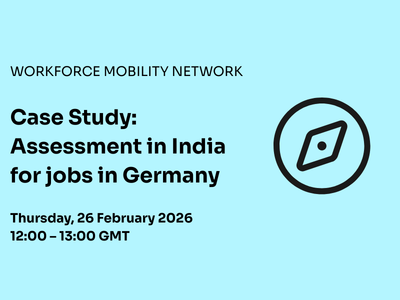
This webinar explores how pathways are built for work and workers between countries and is chaired by Mike Dawe, international workforce development consultant who interviews Tim Miller, founder and CEO of Certif-ID.Certif-ID has been helping firms in Germany to find talent in India for over five years. Their use of assessment and assessment technologies is broad, including direct assessment of skills and employability, assessment of the value of credentials, and the ability of candidates to present themselves at interview.
In this one-hour session, Tim will begin by outlining Certif-ID’s approach to cross-border hiring and the role of assessment within it. He will reflect on what has worked, what has not, and where he sees future risks and opportunities. Mike then explores what this experience tells us about the future of assessment and assessment technologies in an increasingly mobile global workforce.
On 9 June 2025, the eAssessment Association and the Federation of Awarding Bodies convened a high-level round table to address one of the most pressing challenges in global training and employment: how to assure skills and certify talent in a world where employers, learners, and educators increasingly operate across borders.
The session, “Workforce Mobility: Exploring Assessment and Credentialling in an Era of International Workforces,” brought together senior representatives from government agencies, assessment technology providers, qualifications bodies, and leading employers to share insights and begin shaping a response.
The discussion was chaired by Steve Smith, Managing Director of SIAS (Science Industry Assessment Service), the UK’s awarding organisation for the science and technology sectors. Given the global footprint of many industries and the increasingly restrictive political climate around migration, employers are responding not only by seeking to bring skills to where the work is, but also by shifting work to where the skills are. As a result, they—and the organisations supporting their recruitment and training—must work across borders to develop high-quality, portable qualifications that enable workforce readiness, regardless of location.





Join the global community advancing e-assessment through innovation, research, and collaboration.


News
Keep informed