

Accessibility Special Interest Group

Advancing inclusive, accessible assessment through shared expertise and practical action
The Accessibility Special Interest Group (SIG) brings together practitioners, organisations, and experts committed to improving accessibility across digital assessment. The group exists to create a collaborative, member-led space where knowledge is shared, good practice is surfaced, and real-world challenges are discussed openly.
Supported by the e-Assessment Association, the SIG focuses on thought leadership rather than promotion, providing a neutral forum for learning, discussion, and community building. Activities include regular online events, shared resources, and ongoing peer-to-peer engagement, with the goal of supporting the sector to design and deliver assessments that work for all learners.
Inclusive assessment design
Exploring how assessments can be designed to be accessible by default, rather than adapted as an afterthought.
Standards, guidance, and good practice
Sharing practical interpretations of accessibility standards and producing guidance that members can apply in real contexts.
Assistive technologies and innovation
Understanding how tools such as screen readers, braille technologies, and emerging solutions interact with assessment systems.
Community knowledge-sharing
Creating safe spaces for peer discussion, problem-solving, and Q&A through events and ongoing channels.
Learning through events and resources
Delivering webinars, panels, training sessions, and curated content to support continuous professional learning.
Sector collaboration and leadership
Connecting accessibility professionals across organisations to influence best practice across the wider assessment ecosystem.
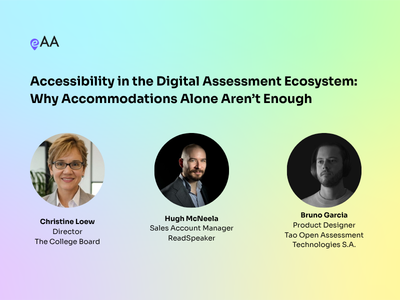
Digital assessment has transformed how organisations measure learning, certification, and professional competence. Yet accessibility is still too often treated as an afterthought, addressed through individual accommodations rather than built into the design of the assessment experience itself.
In this launch webinar for the eAA Accessibility Special Interest Group (SIG), we will explore how accessibility fits into the entire digital assessment ecosystem, from test design and authoring tools to delivery platforms, candidate experience, and regulatory compliance.
An accommodations-first model can create significant challenges. It increases administrative burden, delays access for candidates who need support, and can unintentionally introduce inequities into testing environments, all while placing additional strain on human and financial resources.
Forward-thinking assessment providers are now shifting toward inclusive assessment design, embedding accessibility features directly into digital platforms and workflows from the start. This approach helps create more equitable testing environments while improving operational efficiency and scalability.
Drawing on real-world insights, this session will explore how technologies such as text-to-speech, alongside principles like Universal Design for Learning (UDL), can help organisations design assessments that support diverse candidate needs without compromising test integrity.
Whether you design assessments, manage digital learning platforms, or lead accessibility strategy, this webinar will offer practical perspectives on moving beyond accommodations toward accessibility by design.
View the presentations and transcript here.
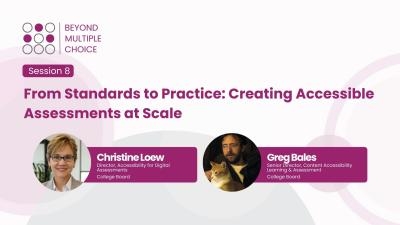
Christine Leow, Director, Accessibility for Digital Assessments at College Board and Greg Bales Senior Director, Content Accessibility Learning and Assessment at College Board explored the importance of grounding assessment design within established web standards, including the Web Content Accessibility Guidelines (WCAG) and MathML, to ensure consistency, usability, and broad compatibility.
The session also highlighted practical principles for creating accessible test content — such as writing effective image descriptions, providing meaningful textual alternatives, and structuring content in ways that support assistive technologies. Demonstrations illustrated how applying these standards and principles results in assessment items that function seamlessly across a wide range of accessibility tools.
Finally, the presenters introduced the inaugural A11y SIG, positioned as a community hub for ongoing collaboration, knowledge-sharing, and advancement in accessible assessment practice.





Join the global community advancing e-assessment through innovation, research, and collaboration.


News
Keep informed