Trifork
Open Standards and AI in Handwritten Essay Assessment
Trifork has partnered with the Institut für Bildungsevaluation (IBE) to develop Handwritten Essay Assessment with AI, bringing AI scoring and feedback to essays written by hand. Schools gain both the educational benefits of handwriting and the speed and consistency of automated assessment.
Most e-assessment technology begins at the point where a response is already digital. This inevitably means leaving work produced on paper out. The educational sector’s seemingly logical solution has been to shift all student responses into the digital domain: fully digitalize the assessment process so that handwritten work is no longer part of it, and the problem disappears.
However, many educational institutions cannot make that trade. Some are bound by examination regulations, some by the benefits of handwriting for younger learners, and some by the fact that paper under invigilation is hard to fake. This comes with its own challenges: as the assessment process is carried out by people, feedback may take weeks to reach the student.
Handwritten Essay Assessment with AI closes this gap without compromising handwritten work. A teacher prints a handout carrying the essay prompt and an anonymous identifier. Students write as they always have, with no technology involved. Completed papers are scanned and uploaded, and from there AI takes over, converting the writing into text and scoring it against the rubric criteria held in the QTI item. AI applies the same criteria to every submission, without the fatigue or sequential bias that affect human reviewers.
Because everything conforms to QTI, these handwritten essay scoring slots fit in perfectly with other automatically scored item types instead of forming a separate data set. The original scan, the extracted text, the score and the feedback all stay linked to the session, which is what matters when a result is moderated or appealed.
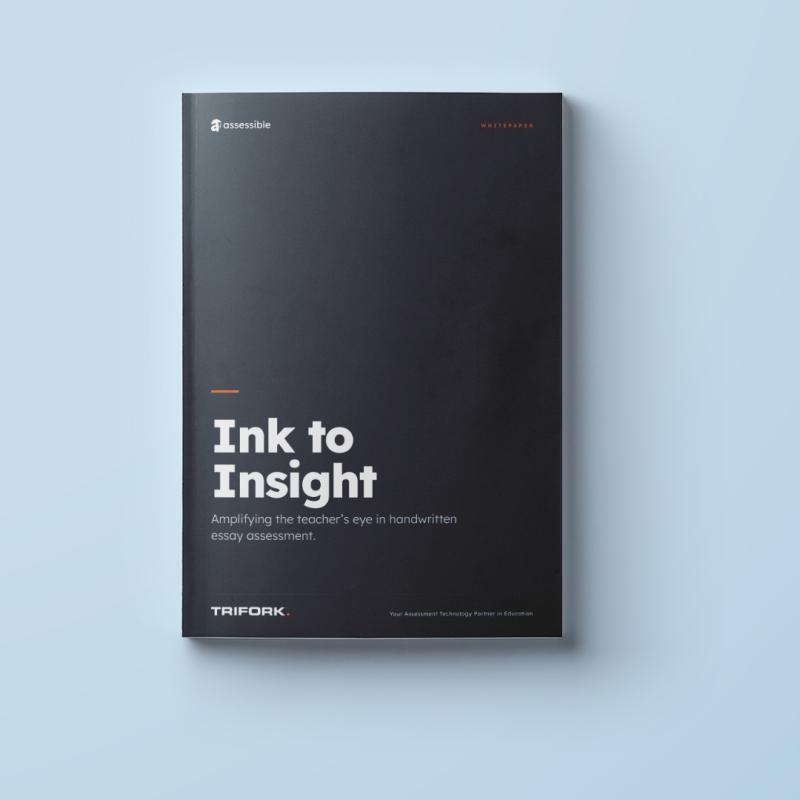
To learn more about this feature from Trifork and IBE, download the whitepaper “Ink to Insight”, which explains the evidence behind the scoring model and the limitations it was designed to work within.