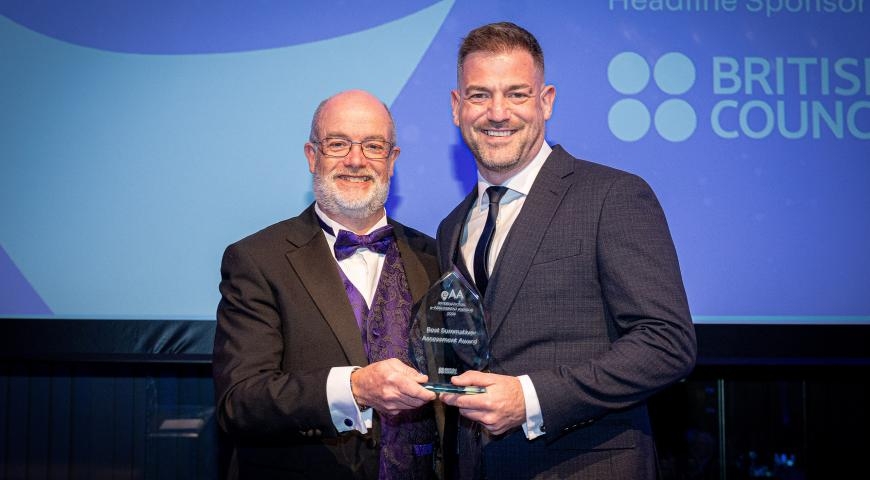
Kaplan Assessments with Solicitors Qualifying Exam (England and Wales)
The SQE is a series of exams which candidates who aspire to become a solicitor must pass before applying for registration. A candidate must first pass the SQE1 which consists of two exams on applied legal knowledge. SQE1 is delivered online in test centres and consists of 360 single best answer questions delivered in four sessions over two days. Once a candidate has passed SQE1 they can apply to take SQE2. This is an exam with sixteen practical legal tasks which the candidate must complete. Most of these are delivered online but a small number are oral stations which are delivered face-to-face. For example, in written stations candidates may be required to prepare documents for a court hearing, or to write a letter of advice to a client. In face-to-face stations, they interview a client and advocate to a judge. Candidates must pass both SQE 1 and 2 as well as completing other requirements before applying to the Solicitors Regulation Authority for registration.
Finalists:
The Simulated Consultation Assessment (SCA) is a national exam taken by doctors training to become GPs. It tests whether they can safely and effectively care for patients. Instead of travelling to a central exam centre, candidates take the assessment in their own GP surgeries using secure online platform. The exam consists of 12 simulated consultations covering a range of conditions a GP would typically manage. Professional role-players act as patients, and each consultation is recorded and later marked by experienced GP examiners. The exam operates on a very large scale. It runs across more than 5,000 GP practices in the UK and has already assessed over 12,000 trainees, generating more than 150,000 recorded consultations. The SCA is delivered nine months a year, during the first week of each month. At peak times, more than 250 candidates sit the exam each day; and around 130 role-players perform simultaneously. Candidates receive their results 5-6 weeks after the examination. Each candidate receives a detailed breakdown of their performance across key skill areas, including developmental feedback. This scale of delivery is essential to meet future GP workforce needs, and the flexible schedule allows candidates to sit the exam when they feel ready.
Hamza for Academic Purposes is comparable in purpose to internationally recognised academic proficiency tests in other languages, such as IELTS and TOEFL for English, HSK for Chinese, and DELF/DALF for French. It reliably serves as an Arabic equivalent of a university-entry academic language assessment, measuring the proficiency of learners of Arabic whose first language is not Arabic. Candidates take the test under secure conditions and receive a score and an official performance certificate. Results can support high-stakes decisions, including university admission, placement into the appropriate language pathway, and progression decisions within academic programmes. Hamza is designed to promote fairness across diverse first-language backgrounds and is supported by rigorous quality assurance processes, including expert item review, piloting, standardised scoring procedures, and ongoing monitoring of test performance. Delivery is practical for both test takers and test administrators, with procedures and consistent reporting. The test is developed by a government institution that has invested to address a long-standing gap: the absence of a well-structured, standardised Arabic proficiency test for academic purposes. The project is guided by international language testing standards and frameworks, while ensuring that test design, score interpretation, and reporting are appropriately adapted to the linguistic characteristics of Arabic through specialised expertise.
Cambridge English Qualifications Digital for Young Learners (DYL) is a new summative test of English for primary-age non-native English speakers. The first two levels (Starters Digital and Movers Digital) launched globally in January 2025; the third level (Flyers Digital) launches in 2027. While Cambridge has provided paper-based young learner English tests since 1997, DYL offers a digital alternative designed to put young people at ease in an online environment that feels more natural than paper and pen. DYL addresses the need to motivate young learners and instil a love of learning while providing an accessible, robust and reliable measure of English. The test has been developed and launched in alignment with schools’ and exam centres’ needs and goals and is now having a positive impact in terms of delighted reactions from students and educators and operational benefits to exam centres.
The SQE is a series of exams which candidates who aspire to become a solicitor must pass before applying for registration. A candidate must first pass the SQE1 which consists of two exams on applied legal knowledge. SQE1 is delivered online in test centres and consists of 360 single best answer questions delivered in four sessions over two days. Once a candidate has passed SQE1 they can apply to take SQE2. This is an exam with sixteen practical legal tasks which the candidate must complete. Most of these are delivered online but a small number are oral stations which are delivered face-to-face. For example, in written stations candidates may be required to prepare documents for a court hearing, or to write a letter of advice to a client. In face-to-face stations, they interview a client and advocate to a judge. Candidates must pass both SQE 1 and 2 as well as completing other requirements before applying to the Solicitors Regulation Authority for registration.


