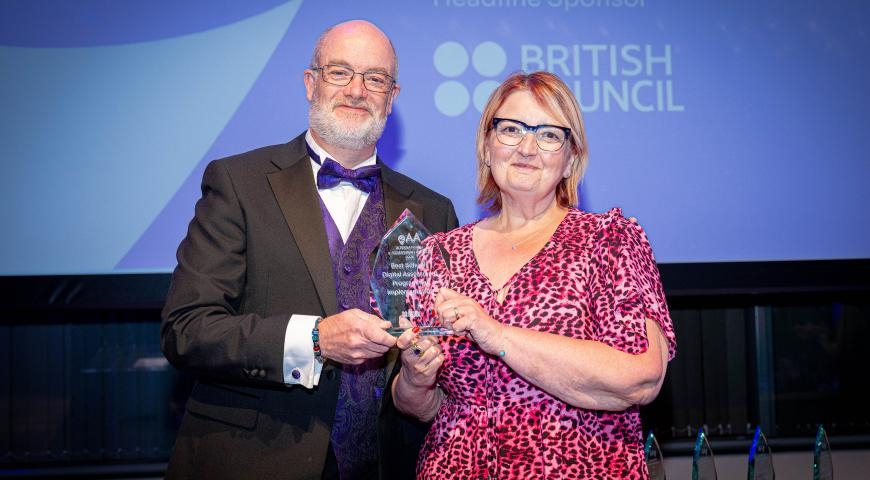
Winner: Woodland Academy Trust with Changing Assessment Culture: From Retrospective Marking to Responsive Digital Practice
Traditionally, assessment often happens after learning, through marking books or tests, which can take a lot of time and doesn’t always help teachers respond quickly to what pupils need. We wanted to change that. Our project is about making assessment work better for both children and teachers.
Across our schools, we now use Magma Maths to help teachers see, during the lesson, what pupils understand and where they are struggling. As children work, teachers can immediately spot misunderstandings, adjust tasks, offer extra support or stretch pupils further, all in real time.
This means children are more confident because the work is pitched at the right level for them. They are less worried about getting things wrong and more willing to try. For pupils who find learning harder, especially those with additional needs, this makes learning feel fairer and more accessible.
For teachers, it reduces time spent marking and paperwork, allowing them to focus on teaching and supporting pupils.
In simple terms, our project uses digital assessment to help teachers teach better in the moment, and to help children feel more successful while they are learning.
Finalists:
Cambridge English Qualifications Digital for young learners (DYL) is a new summative test of English for primary-age non-native English speakers. The first two levels (Starters Digital and Movers Digital) launched globally in January 2025; the third level (Flyers Digital) launches in 2027. While Cambridge has provided paper-based young learner English tests since 1997, DYL offers a digital alternative designed to put young people at ease in an online environment that feels more natural than paper and pen. Tenidiomas is both a private language school and exam centre in Jerez, Spain. The school participated in pilot sessions to help validate DYL before its launch, and has now entered 54 of their own candidates. Input in this submission is from centre manager Gerry and English teachers Anna, Rachel and Molly. We are entering DYL for the category of Best School Digital Assessment Programme/Implementation because of its extremely positive uptake by the school, its beneficial impact on students' and parents' attitude to test-taking for young learners and the way it aligns with the school's improvement goals and approach to test preparation. As Anna says, “It's the perfect way to start their exams life.
When students prepare for vocational qualifications, practice assessments are essential. However, since these subjects are closely tied to industry developments, they typically lack past papers for formative testing. In addition, teacher-marked exams can take weeks for feedback to reach learners. By then, the feedback loses much of its value. NCFE wanted to provide a solution that would enable faster, comprehensive personalised feedback, more like having a personal tutor available around the clock, providing support for all learners regardless of circumstance. This project introduced a formative platform that lets learners complete five practice assessments and immediately receive detailed, personalised feedback. The system explains not just the mark, but why the answer scored as it did and how to improve. Learners can ask for worked examples, request a mini lesson on a topic, or revise their answer and resubmit for auto marking. Teachers can see exactly how each learner is progressing, where the gaps are, and where to focus their teaching time. Six schools piloted this approach with 289 learners studying the NCFE Level 1/2 Technical Award in Health and Fitness. The aim was to raise attainment by giving learners more opportunities to practise and learn from their mistakes in real time.
Every year, the regional government in Galicia gives funding so thousands of secondary and vocational students can take an official English exam. Until recently, most students took long, paper based tests run by a single provider. These exams were time consuming, stressful, slow to mark, and often required schools to travel or fit into rigid schedules. In some cases, the government subsidy didn’t cover the full cost, so students had to pay extra. A new option became available through the Oxford Test of English, a modern online exam that is shorter, flexible, and gives quick results. An OUP partner in Spain, English in Motion, saw the opportunity to bring these tests directly to schools using their own equipment, making the experience easier for schools and students. Because the test adapts to each student’s level, most students receive a certificate that reflects their real ability rather than a pass/fail outcome. Teachers appreciate that the test aligns well with what they already teach, and students feel less anxious and perform better. What started with a few schools has grown rapidly into hundreds of centres and thousands of students, becoming a successful model that other regions are now beginning to follow.
Traditionally, assessment often happens after learning, through marking books or tests, which can take a lot of time and doesn’t always help teachers respond quickly to what pupils need. We wanted to change that. Our project is about making assessment work better for both children and teachers. Across our schools, we now use Magma Maths to help teachers see, during the lesson, what pupils understand and where they are struggling. As children work, teachers can immediately spot misunderstandings, adjust tasks, offer extra support or stretch pupils further, all in real time. This means children are more confident because the work is pitched at the right level for them. They are less worried about getting things wrong and more willing to try. For pupils who find learning harder, especially those with additional needs, this makes learning feel fairer and more accessible. For teachers, it reduces time spent marking and paperwork, allowing them to focus on teaching and supporting pupils. In simple terms, our project uses digital assessment to help teachers teach better in the moment, and to help children feel more successful while they are learning.


