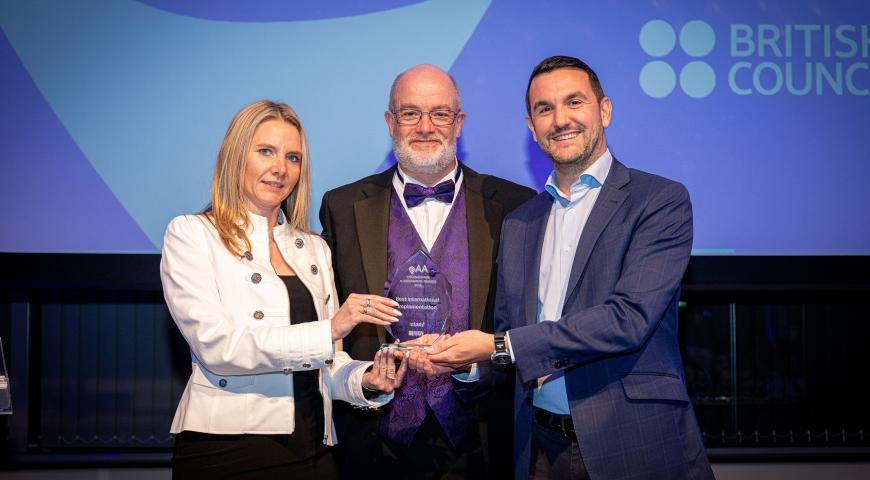
Winner: Open Assessment Technologies with One Platform. One Survey. Delivering PISA 2025 to the World — Online and Offline
PISA is one of the world's biggest international testing programs, serving as a global “check-up” of what 15-year-olds know and can do. It's taken by students in many countries so results can be benchmarked and compared fairly. In 2025, it moved online for the first time in the programme’s history, which meant we had to make it work reliably in real classrooms worldwide on different computers, in 54 languages, and with very different internet access. We implemented the test delivery solution for the largest and most complex cycles in the programme's history. Our job was to make the test simple for schools to run: students log in, the system automatically gives the right test and language, and every answer is saved securely. If a school can’t rely on the internet, the test can still run offline and then safely upload later. We also supported newer digital parts of the test, like listening activities and recording spoken answers, while ensuring nothing is lost and the data is trustworthy.
Finalists:
This project is about helping a global company run exams and certifications for its employees in a simpler and more reliable way across the globe. Nokia has employees across many countries, time zones and languages. Earlier, different regions used different exam systems, which made assessments hard to manage, inconsistent and sometimes unreliable. With an urgent need to move to a new system, Nokia wanted one global solution that could work everywhere while still respecting local rules, languages and internet conditions. We worked with Nokia to create a single digital exam platform that connects directly to their existing learning system. Employees can take certification exams securely online, with monitoring to protect exam integrity, using a process that feels the same whether they are in Europe, India or America. Behind the scenes, the system automatically handles time zones, scheduling, security checks, and regional technical differences. Special adjustments were made for challenging environments such as regions with restricted internet access, to ensure exams could still run smoothly. Employees and administrators were trained and supported throughout the transition. As a result, exams are now easier to deliver, streamlined and more reliable worldwide for Nokia.
Cambridge wanted to make one of its English language exams available to people around the world without requiring them to travel to a physical test centre or rely on in-person invigilators. The challenge was to do this while keeping the exam secure, fair and trusted across many countries. Working with Talview, Cambridge redesigned how the exam is delivered so it can be taken either in approved centres or remotely from anywhere, while still being monitored and reviewed securely. The system records exam sessions and allows trained reviewers to check them later, rather than needing someone physically present during every test. The project had to work across different countries, time zones, and levels of digital readiness, and it needed to fit into Cambridge’s existing exam platform without disrupting candidates. Today, the exam is delivered internationally, supports thousands of candidates in short time windows, and offers round-the-clock support, making it easier for people worldwide to access a trusted, certificated exam.
PISA is one of the world's biggest international testing programs, serving as a global “check-up” of what 15-year-olds know and can do. It's taken by students in many countries so results can be benchmarked and compared fairly. In 2025, it moved online for the first time in the programme’s history, which meant we had to make it work reliably in real classrooms worldwide on different computers, in 54 languages, and with very different internet access. We implemented the test delivery solution for the largest and most complex cycles in the programme's history. Our job was to make the test simple for schools to run: students log in, the system automatically gives the right test and language, and every answer is saved securely. If a school can’t rely on the internet, the test can still run offline and then safely upload later. We also supported newer digital parts of the test, like listening activities and recording spoken answers, while ensuring nothing is lost and the data is trustworthy.


