Privacy concerns with online proctoring and how to address them
PSI
Lobke Spruijt
Education Specialist
2nd December 2025
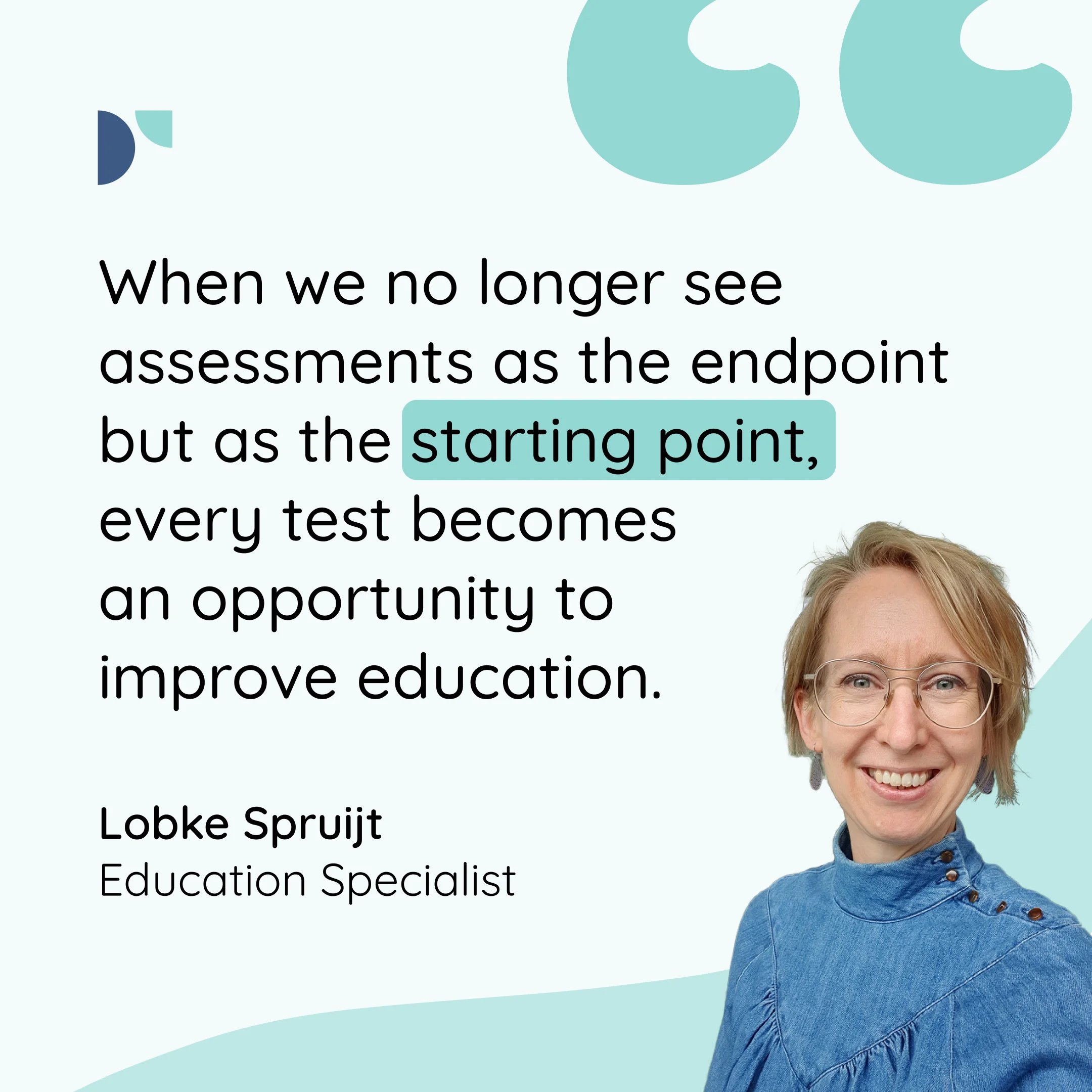
Assessments often feel like the finish line. Students prepare for weeks, and teachers do everything they can to organize the test period smoothly. Once the grades are in, everyone breathes a sigh of relief. Passed or failed — done.
But what if every assessment were actually the starting point for better education?
As an educational specialist, I often see how assessment periods feel like a daunting task. For students, everything revolves around one question: Did I make it? For teachers, examination offices, and schedulers, it’s about logistics and organization.
And honestly, once it’s over, the main feeling is often relief. The test has been taken, and the results have been processed — we can move on. But in doing so, we might be missing the biggest opportunity that assessment offers.
Because an test is so much more than a measuring stick. Digital assessment makes this visible: it not only provides insight into individual student performance but also reveals broader patterns of performance. Which topics do students struggle with most? Where do many drop off? And which areas seem to be landing well?
Increasingly, we are seeing educational approaches such as learning-oriented assessment and programmatic testing. Some advocates might argue that “testing” doesn’t fit into these models — but in my view, an exam can also be a powerful feedback moment. Not only for students, but for teachers, test developers, and the education system itself.
Every assessment delivers valuable information we can use to improve: questions can be refined, learning content can be better aligned, and curricula can evolve further.
It does, however, require a shift in mindset. We need to stop seeing exams as the endpoint and start seeing them as part of a continuous (assessment) cycle — one in which analyzing and reflecting are just as important as administering and grading. A cycle where assessment fuels quality, rather than closes a period.
Imagine if every assessment became a source of insight: For students — “Where do I stand now, what do I already master, and what’s my next step?” For teachers — “What patterns do I see in my group, and how can I adjust next week’s lessons?” For educational institutions — “How do we systematically use assessment data to improve overall quality?”
When we start to view assessing this way, its role changes fundamentally. It’s no longer just an instrument of evaluation, but a tool for improvement. No longer a conclusion, but a beginning. And in that shift, I believe, lies a key to better education.
Join the global community advancing e-assessment through innovation, research, and collaboration.


Keep informed
This site uses cookies to monitor site performance and provide a mode responsive and personalised experience. You must agree to our use of certain cookies. For more information on how we use and manage cookies, please read our Privacy Policy.